
Understanding Thermoacoustics
This guide approaches thermoacoustics through the physical and design questions researchers address, alongside its history. It connects theoretical foundations, experimental examples and recent numerical work, while distinguishing the evidence each provides.
01 / FOUNDATIONS
Looking inside the interaction of heat and sound
Why does the timing of heat exchange matter?
A gas parcel heats and cools as it is compressed and expanded by sound. When it exchanges heat with a solid surface within that cycle determines whether acoustic energy is supplied or consumed. Rayleigh’s phase argument provides a starting point, while Rott’s framework accounts for wall effects. A hot end and a cold end alone therefore do not establish that a device will operate as an engine. [1], [2], [4]
Are a stack and a regenerator interchangeable?
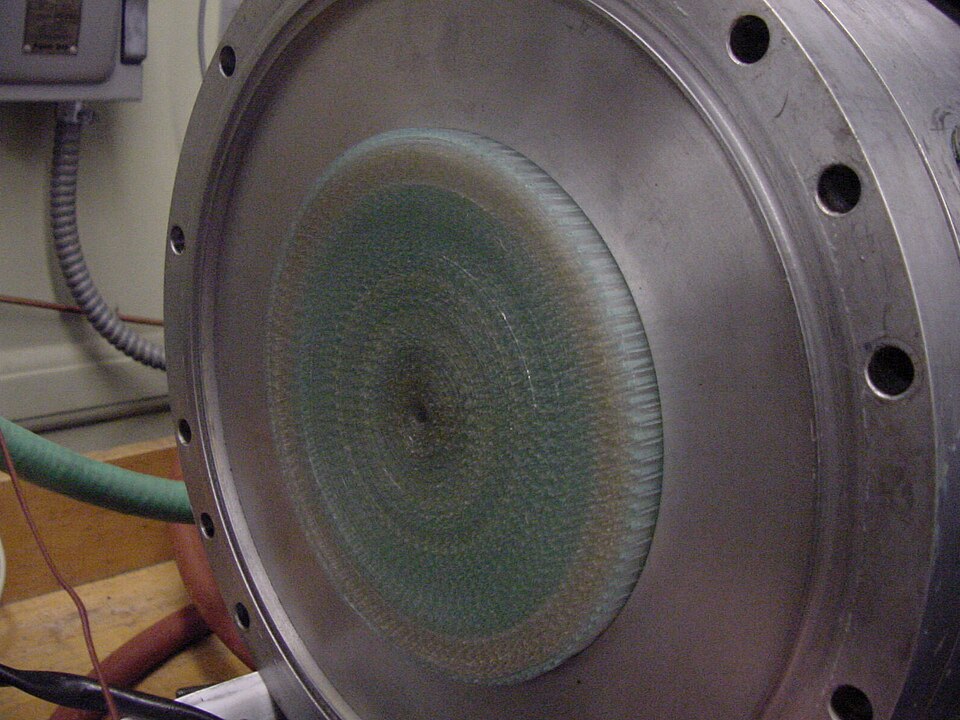
Parallel-plate stack: a general thermoacoustics example · Aadiwa (English Wikibooks) · Wikimedia Commons · CC BY-SA 2.5
Both structures provide thermal contact between oscillating gas and a solid, but they are designed for different acoustic and thermal conditions. Channel spacing must be considered alongside the distance over which heat diffuses during a cycle. Tijani and colleagues found that the spacing giving the lowest temperature need not be the spacing giving the greatest cooling power. An “optimal geometry” therefore needs a stated objective. [8], [9], [10]
Does high sound pressure imply high useful power?
Acoustic power depends on pressure, volume flow and their phase relationship. With peak-amplitude complex phasors, time-averaged power is ½ Re(p₁U₁*). A strong standing wave can have a large pressure amplitude yet carry limited net power. The two-sensor method of Fusco and colleagues illustrates why power assessment in a lossy duct cannot be reduced to a single pressure measurement. [11]
02 / APPROACHES
Thermoacoustics encompasses several architectures
Approach | Operating idea | Reading focus |
|---|---|---|
Standing wave | Position-dependent pressure and velocity fields interact with a stack. | Assess geometry, thermal contact and dissipation together. |
Travelling wave / Stirling approach | Pressure–velocity phasing supports Stirling-like energy exchange in a regenerator. | Control phase matching and mean flow. |
Acoustically driven refrigerator | An external driver or another thermoacoustic engine supplies acoustic power to move heat from a cold region. | Report cooling load, temperature span and acoustic/electrical input together. |
Heat-driven combined system | A heat engine supplies a refrigerator or another load through an acoustic connection. | Account for the complete chain from heat source to useful output. |
Real devices can combine features of ideal categories. A standing- or travelling-wave label does not replace measurements of phase and energy flow. [3], [5], [6], [10], [14]
03 / RESEARCH QUESTIONS
How to assess a design
Which system boundary defines COP and efficiency?
Cooling power divided by acoustic power reaching the core is a different metric from cooling power divided by electrical input at the wall. A heat-driven combined device also has a thermal input to its engine. Comparisons should therefore retain temperature span, cooling load, ambient conditions and the energy-accounting boundary. NIST’s cryocooler study likewise separates compressor losses from losses in acoustic transmission. [8], [21]
Why are heat exchangers a research topic of their own?
Oscillating gas repeatedly reverses direction rather than moving steadily downstream. A correlation developed for steady flow may therefore be inappropriate without checking its assumptions. Increasing heat-transfer area can also change viscous losses, dead volume and acoustic matching. Arefin and colleagues’ review is a recent entry point for examining geometries, experimental conditions and the validity of heat-transfer correlations together. [17]
Streaming and nonlinear losses
Time-averaged gas motion accompanying an oscillation can transport unwanted heat. Loop-wide circulation and local boundary-driven streaming are distinct mechanisms. Jet pumps can suppress some flows, but introduce their own loss and stability questions. The stability study of Backhaus and Swift and the stack-plate flow calculation of Marx and Blanc-Benon offer complementary examples of effects that a purely linear acoustic description may miss. [12], [13]

How should network models, CFD and experiments be read together?
DeltaEC integrates a one-dimensional, single-frequency wave equation through a specified geometry. CFD can resolve local flow and nonlinear processes, but more detailed modelling does not automatically provide greater accuracy. Boundary conditions, loss representation and comparison with experiments should be explicit. A calculation with an imposed acoustic field is also different evidence from a demonstrated self-starting oscillation or a measured steady generated amplitude. [16], [19], [20]
From solar heat to cooling: reading the complete chain
Adeff and Hofler’s prototype is an early experimental example of a solar-heated engine acoustically driving a refrigerator. System assessment must also consider heat collection, energy transfer and changing ambient conditions. For concentrating solar applications, direct normal irradiance and global horizontal irradiance are distinct quantities. Weather-model values are useful context, but do not measure the actual cooling performance of an apparatus. [7], [18]
Which questions become more important when scaling up?
Moving from a laboratory demonstration to sustained operation raises questions about part-load behaviour, heat-source integration, sealing, radiated sound and maintenance. An acoustic core without moving parts does not imply that the complete installation has no fans, pumps or transducers. A reported temperature or efficiency should not be transferred to another scale without retaining the operating conditions and system boundary. [5], [6], [14], [18]
04 / READING PATHWAY
Where to begin, and what to ask next?
Build the concepts
Move from Rayleigh’s phase argument to Rott and Swift. Follow heat, acoustic power and loss terms separately. [1], [2], [4], [15]
Follow one architecture
Read Ceperley alongside the Backhaus–Swift engine or Yazaki’s cooler to distinguish an idea from an experimental realization. [3], [5], [6], [10]
Examine design variables
Compare Tijani’s design method with the stack-spacing experiment. Ask which objective was optimized. [8], [9]
Question the evidence
Consider power measurement, mean flows and the assumptions of DeltaEC within one assessment. [11], [12], [13], [16]
Connect to current work
Use recent exchanger and hot-climate reviews to approach new numerical studies. Check the evidence labels on the news cards. [17], [18], [19], [20]
History, Pioneers and Selected References
05 / SCIENTIFIC HISTORY
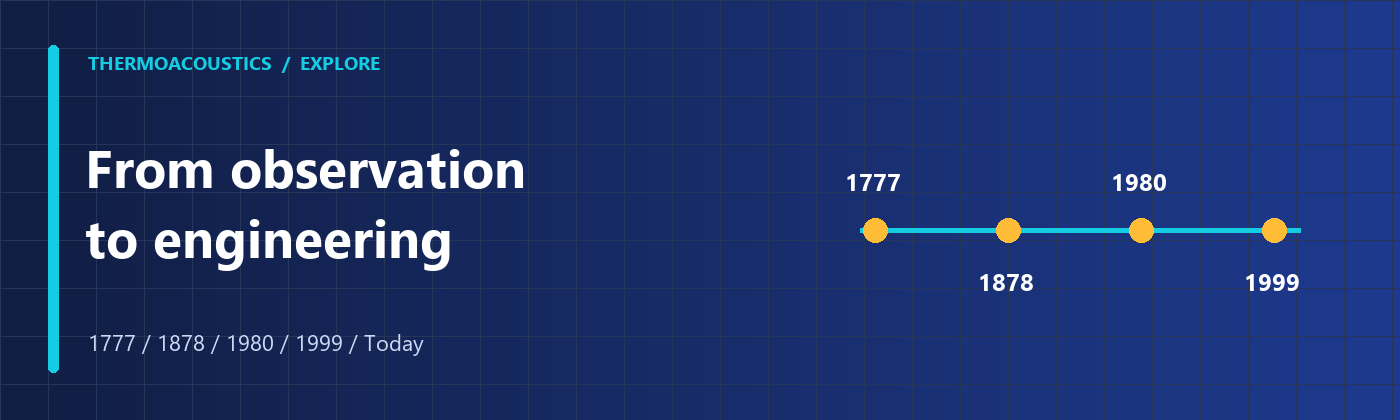
From observation to measurable design
Year | Scientific milestone and source |
|---|---|
1777 | Byron Higgins: early observations of sound produced by a flame inside a tube. [14] |
1850 | Carl Sondhauss: investigation of sound generation in heated glass tubes. [14] |
1859 | Pieter Leonard Rijke: sustained oscillations with heated gauze in an open tube. [14] |
1878 | Rayleigh: the phase of heat addition within a cycle. [1] |
1979 | Ceperley: the pistonless Stirling and travelling-wave concept. [3] |
1980 | Rott: a comprehensive framework for thermoacoustic theory. [2] |
1988 | Swift: a common physical perspective on engines and refrigerators. [4] |
1992 | Fusco, Ward and Swift: power measurement in lossy ducts. [11] |
1999–2000 | Backhaus and Swift: an experimental Stirling engine and detailed energy analysis. [5], [6] |
2000 | Adeff and Hofler: a solar-heated refrigerator prototype. [7] |
2002 | Tijani and colleagues: design and stack spacing; Yazaki and colleagues: a pistonless cooler. [8], [9], [10] |
2003–2004 | Streaming stability and investigation of local mean flows. [12], [13] |
2015–2017 | Jin’s field review and the second edition of Swift’s textbook. [14], [15] |
2025–2026 | Multi-platform design tools, exchanger and hot-climate reviews, and new modelling studies. [16], [17], [18], [19], [20] |
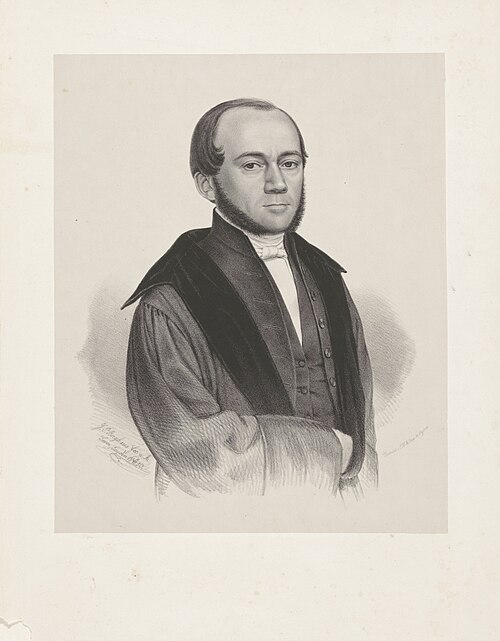
Portrait of Pieter Leonard Rijke (1850). — Johann Peter Berghaus / Rijksmuseum. Wikimedia Commons · CC0 1.0. Display size only.
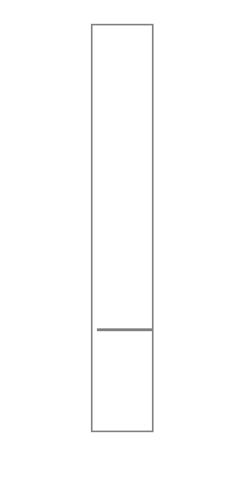
Schematic of a Rijke tube, a classic experiment demonstrating heat driven acoustic oscillation. — BobChan2. Wikimedia Commons · CC BY-SA 4.0. Display size only.
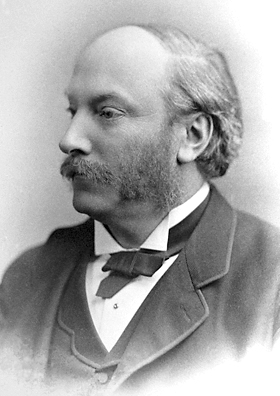
John William Strutt, Lord Rayleigh. — Nobel Foundation. Wikimedia Commons · CC BY 4.0. Display size only.
06 / REFERENCES
21 selected sources
Links lead to publishers, author institutions or developer sources. This is a curated reading guide rather than a systematic review of the entire field. Some full texts may require institutional access.
Theory
Rayleigh (1878). The explanation of certain acoustical phenomena. Nature 18, 319–321.
Theory
N. Rott (1980). Thermoacoustics. Advances in Applied Mechanics 20, 135–175.
Concept
P. H. Ceperley (1979). A pistonless Stirling engine—The traveling wave heat engine. JASA 66, 1508–1513.
Theory / review
G. W. Swift (1988). Thermoacoustic engines. JASA 84, 1145–1180.
Experiment
S. Backhaus & G. W. Swift (1999). A thermoacoustic Stirling heat engine. Nature 399, 335–338.
Theory / experiment
S. Backhaus & G. W. Swift (2000). A thermoacoustic-Stirling heat engine: Detailed study. JASA 107, 3148–3166.
Solar prototype
J. A. Adeff & T. J. Hofler (2000). Design and construction of a solar-powered, thermoacoustically driven, thermoacoustic refrigerator. JASA 107, L37–L42.
Design method
M. E. H. Tijani, J. C. H. Zeegers & A. T. A. M. de Waele (2002). Design of thermoacoustic refrigerators. Cryogenics 42, 49–57.
Experiment
M. E. H. Tijani, J. C. H. Zeegers & A. T. A. M. de Waele (2002). The optimal stack spacing for thermoacoustic refrigeration. JASA 112, 128–133.
Experimental prototype
T. Yazaki, T. Biwa & A. Tominaga (2002). A pistonless Stirling cooler. Applied Physics Letters 80, 157–159.
Measurement method
A. M. Fusco, W. C. Ward & G. W. Swift (1992). Two-sensor power measurements in lossy ducts. JASA 91, 2229–2235.
Stability / losses
S. Backhaus & G. W. Swift (2003). An acoustic streaming instability in thermoacoustic devices utilizing jet pumps. JASA 113, 1317–1324.
Flow simulation
D. Marx & P. Blanc-Benon (2004). Computation of the mean velocity field above a stack plate in a thermoacoustic refrigerator. Comptes Rendus Mécanique 332, 867–874.
Field review
T. Jin, J. Huang, Y. Feng, R. Yang, K. Tang & R. Radebaugh (2015). Thermoacoustic prime movers and refrigerators: Thermally powered engines without moving components. Energy 93, 828–853.
Textbook
G. W. Swift (2017). Thermoacoustics: A Unifying Perspective for Some Engines and Refrigerators. Springer, 2nd edition.
Software / method
Los Alamos Thermoacoustics / DeltaEC geliştiricileri (2025). DeltaEC 7.0.2 and the Users Guide. Design Environment for Low-amplitude Thermoacoustic Energy Conversion.
Recent review
M. A. Arefin, I. Ramadan & H. Bailliet (2026). Heat exchangers for thermoacoustic systems: A review. Applied Thermal Engineering, 129093.
Recent review
I. Farikhah & A. M. Bahman (2026). Heat-driven thermoacoustic cooling technologies: A comprehensive review and future prospects for hot climate applications. International Journal of Refrigeration 183, 153–187.
Numerical study
W. Sun, G. Chen, L. Tang & K. C. Aw (2026). Thermally-tunable acoustic power amplification and efficiency enhancement in thermoacoustic amplifier. International Communications in Heat and Mass Transfer 178, 111758.
Numerical study
N. Duman & H. İ. Acar (2026). Simulation of a Standing Wave Thermoacoustic Refrigerator Using PLA as Stack Material. Gazi Üniversitesi Fen Bilimleri Dergisi Part C, online first.
Measurement / modelling
R. Snodgrass, V. Kotsubo, J. Hoehne & J. Ullom (2026). Low-frequency cryocoolers are compressed inefficiently. Physical Review Applied 25, issue 3.
Thermoacoustics News
Selected developments in publications, field demonstrations and research tools.